AI Strategy for Digital Evolution: A Plan for Small and Medium-Sized Businesses
How small and medium-sized businesses build an AI strategy: four building blocks, four steps and the rules that belong in from day one.
An AI strategy for digital evolution answers three questions: where does your business lose time today, which of those tasks can AI handle reliably, and how will you know it pays off. For small and medium-sized businesses, a two-page plan and one first use case that runs within a few weeks are enough.
Why an AI strategy comes before the first tool
Many businesses start with a tool. A ChatGPT account for the office, a chatbot plugin for the website, a trial version for invoices. Three months later nobody knows exactly what it achieved, and the data sits in four different places.
A strategy turns the order around: first the problem, then the solution, and the tool last. By “digital evolution” we mean that your business changes step by step. Each step has to work on its own and prepare the next one. For a small team that is far easier to live with than an overhaul that disrupts daily work for half a year.
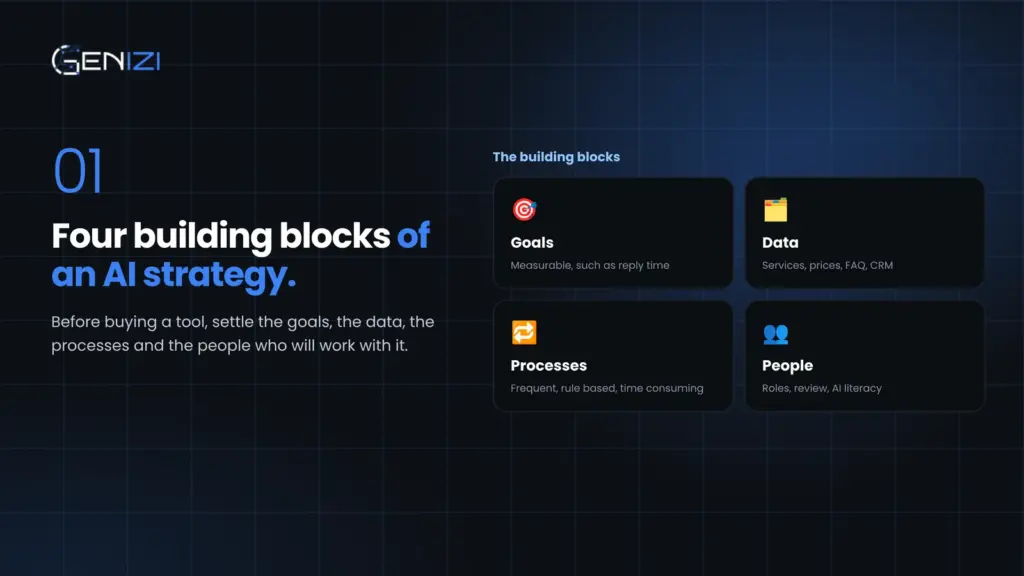
The four building blocks of an AI strategy
Goals you can count
“We want to use AI” is a wish. A goal sounds like this: answer evening enquiries straight away, send quotes two days sooner, take fewer calls while you are on site. You can check goals like these after three months.
Data that AI can work with
AI works with what you give it. For a website chatbot that means your service pages, prices and frequent questions. For automations it means emails, forms and your CRM. Check early where this data lives and whether it is up to date. Outdated prices on your website will otherwise end up word for word in the chatbot’s answers.
Processes that repeat
Good candidates happen often, follow fixed rules and cost noticeable time today. Typical examples are sorting enquiries, arranging appointments, moving form data into the CRM and answering the same questions again and again.
People who work with it
Decide who on the team works with the system, who checks the results and who is the contact person. Since February 2025 the EU AI Act also requires staff who use AI systems to have sufficient AI literacy. A short briefing with clear rules belongs in every plan.
Four steps from idea to a running system
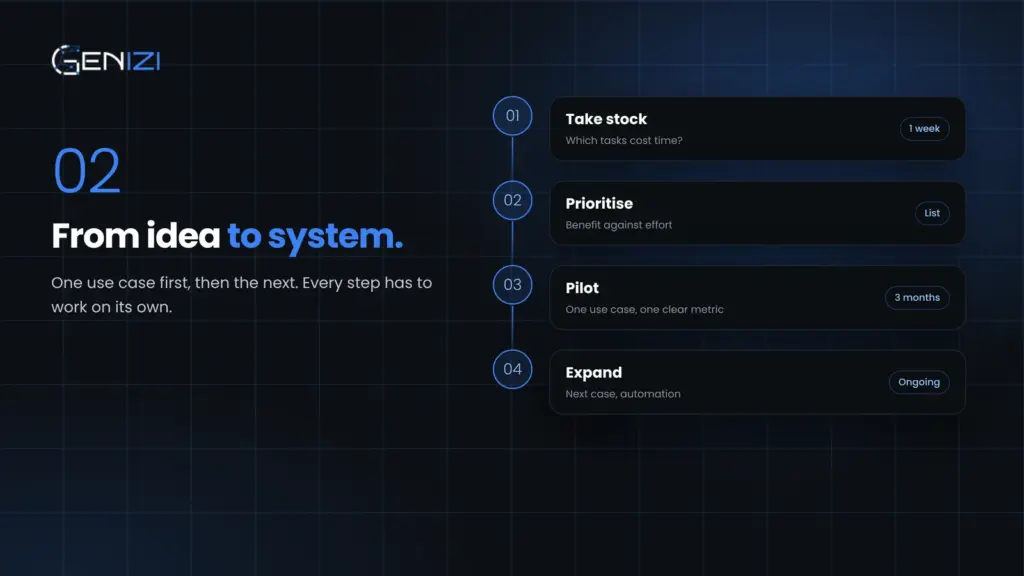
- Take stock: For one week, write down which tasks repeat and how long they take. A simple list on paper is enough.
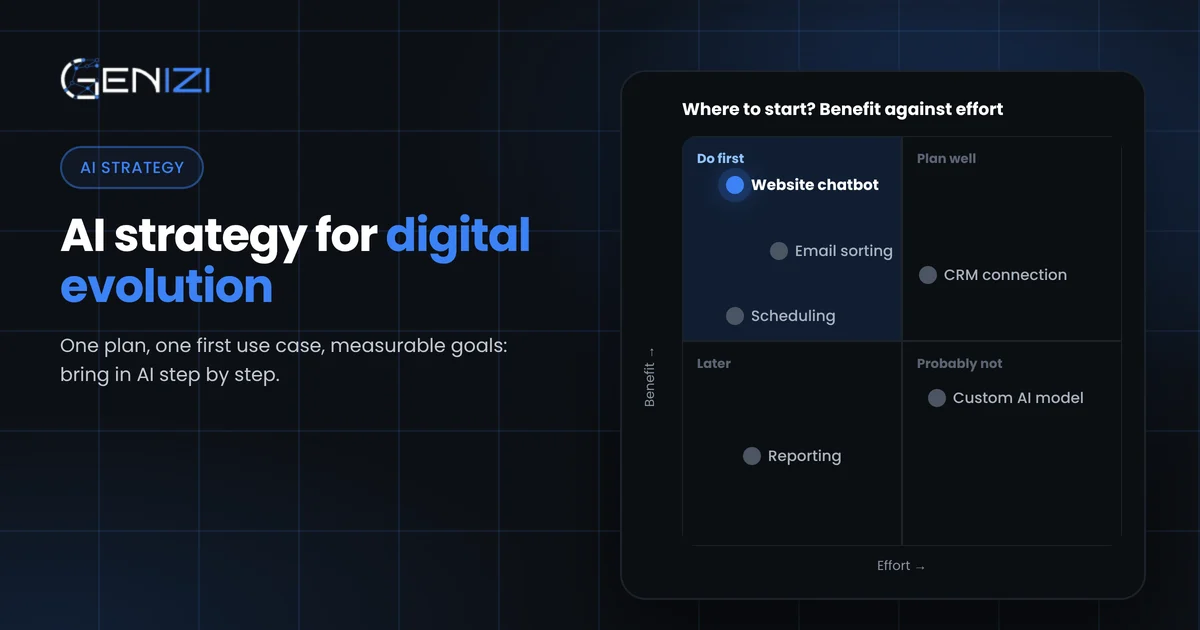
- Prioritise: Rate each task by benefit and effort. Start with the case that brings a lot and needs little change. For many small businesses that is customer contact through the website.
- Pilot: Put exactly one use case into practice and let it run for three months. Decide beforehand how you will measure success, for example by the number of enquiries outside opening hours.
- Expand: If the pilot works, add the next case. Often that is an automation that passes enquiries from the chatbot straight into your CRM or calendar.
Typical first use cases for SMEs
| Use case | What AI takes over | What stays with you |
|---|---|---|
| Website chatbot | Answer standard questions, collect enquiries with key details | Advice and quote |
| Email pre-sorting | Recognise and assign requests, prepare a draft reply | Approving the reply |
| Workflow automation | Move data between form, CRM and calendar | Setting the rules |
| Reporting | Build reports from figures you already have | Making decisions |
A website chatbot is often the best way in. It is visible straight away, it touches your customers directly and you can measure it with one clear number. We show what that looks like in practice in our article on AI chatbot integration for your website.
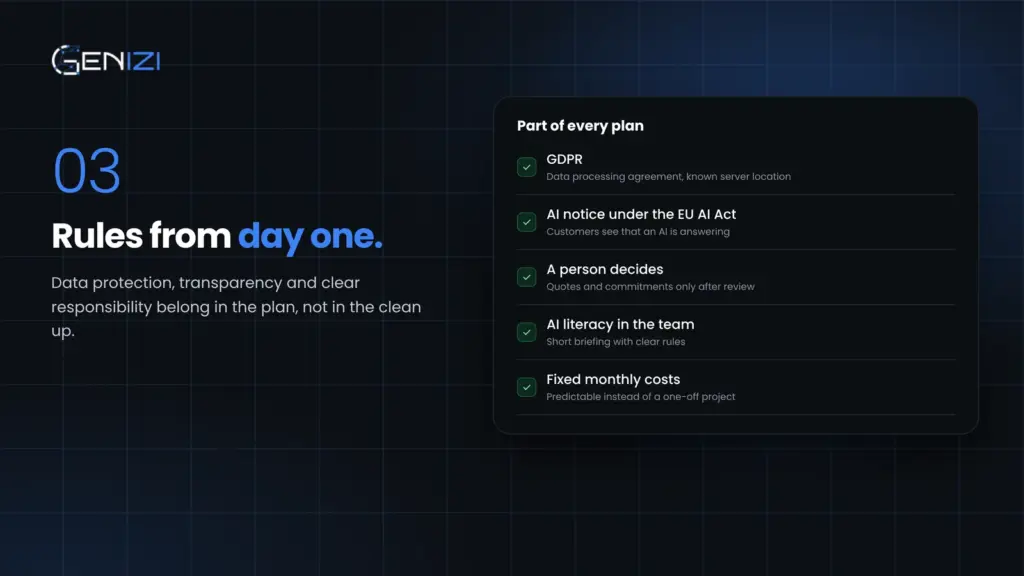
Rules that belong in from day one
Data protection under the GDPR
You may only process personal data on a legal basis. With every AI provider you need a data processing agreement, and you should know where the data is processed. Customer data does not belong in employees’ private AI accounts.
Transparency under the EU AI Act
People must be able to tell that they are talking to an AI. A chatbot on your website therefore gets a clearly visible notice that an AI assistant is answering.
A person makes the decision
AI prepares, you decide. Quotes, prices and commitments leave your business only after you have checked them.
Monthly costs instead of a one-off project
Plan for running costs, not just the setup. Genizi offers fixed AI packages for this: KI Starter at €149, KI Business at €399 and KI Enterprise from €899 a month, each with a three-month minimum term and cancellable monthly after that. All prices without VAT under § 19 UStG.
How Genizi supports your AI strategy
Genizi is a web agency from Schrobenhausen working with businesses across Bavaria. In a first call we look at your processes together and suggest a first use case that fits your business. You then receive a quote with a fixed monthly price. Setup and briefing are included in the package, and we speak German, Polish and English.
The best time for your AI strategy is before the first tool. Send us a short note on where your business loses time today, and we will get back to you within 24 hours.
Next step
Want to put this into practice for your business?
Send us a quick WhatsApp message. Within 24 hours you get an honest assessment of what is worth doing on your website and what is not.